
What Is PU Figure?
To understand PU prototypes and PU figures, it is necessary to first learn about polyurethane (PU) resin. As a high-molecular polymer, PU resin has better physical properties than PVC and ABS. Once cured, it delivers excellent toughness and deformation resistance, with no oil sweating under sunlight exposure, and provides a smooth, ivory-like surface texture.
PU figures are art toys made from PU resin, mainly produced via two mainstream processes: light-cure 3D printing for PU prototype development, and silicone mold casting for small-batch finished PU figures.
Within designer toy and art toy communities, the term “resin toys” generally refers to items made of PU resin. Even so, the inherent properties of this material make it unsuitable for mass-produced designer toy lines.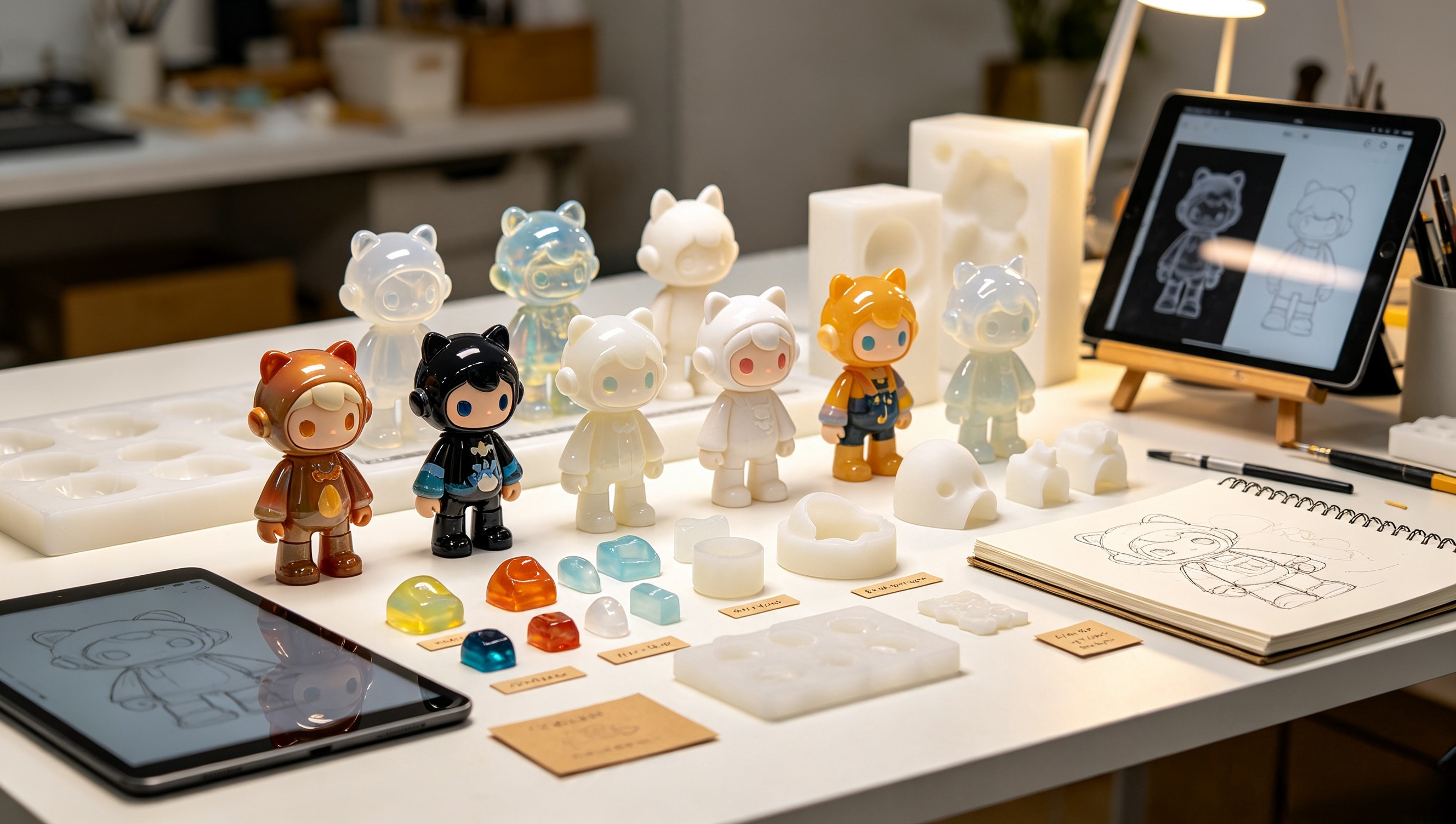
In the toy industry, PU resin serves as the primary material for GK model kits, commonly known as “HEI-CAST resin”. It is a two-component material with Part A and Part B, mixed in equal proportions for fast molding. In China, this mixed liquid is widely called “AB water”.
PU resin offers great versatility in toy manufacturing. It excels at reproducing fine details and delivers a premium tactile feel.
Despite its many advantages, PU resin figures have noticeable drawbacks and cost disadvantages compared to conventional PVC and ABS plastic figures. Finished PU pieces are harder yet more brittle, requiring careful handling during transport to prevent damage. While the molding process itself is low-cost — PU resin can be cast at room temperature using only silicone molds — silicone molds have a limited service life. They typically degrade after roughly ten pours, limiting production to small-batch custom figurines instead of large-scale manufacturing.
Furthermore, silicone molds cannot match the precision and stability of metal molds, which often leads to minor variations in product shape and surface finish. This prevents the use of automated production and automated painting. Post-production manual trimming and hand painting are therefore required, greatly pushing up labor costs.
Thanks to its outstanding detail reproduction capability, PU resin is widely used for small-batch artist toys and designer toys. However, high raw material costs, limited mold lifespan and heavy manual work result in a far higher unit production cost than mainstream PVC figures.
快速导航
联系我们

关注我们

